
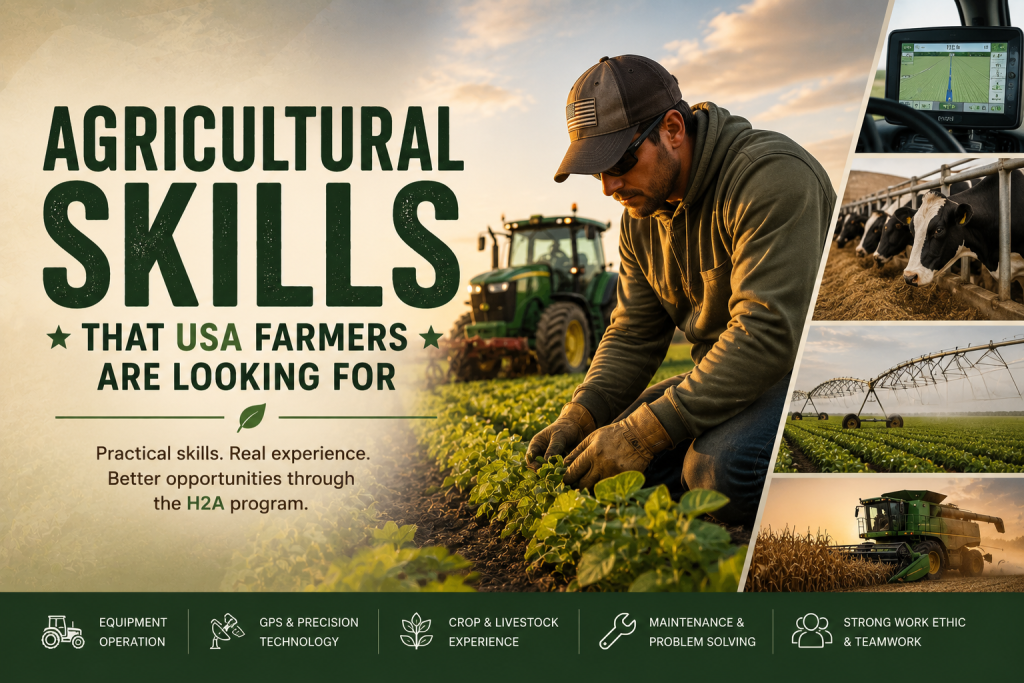
Agricultural work in the United States often involves modern equipment, practical problem-solving, physical labour, and the ability to work efficiently during demanding farming seasons.
While every farm and position is different, certain skills and experience can improve a candidate’s opportunities within the H2A program.
In this guide, we explore some of the agricultural skills that USA farmers commonly look for when hiring seasonal workers.
Tractor & Equipment Operation
One of the most valuable skills in modern agriculture is the ability to safely operate tractors and farming equipment.
Many USA farms use:
- Large tractors
- Harvesting equipment
- Feed mixers
- Balers
- Sprayers
- Implements & attachments
Candidates with practical experience operating agricultural machinery may have access to more opportunities, especially on large commercial farms.
Experience with different makes and models can also be beneficial.
GPS & Precision Farming Systems
Modern agriculture increasingly uses technology and precision farming systems to improve efficiency and productivity.
Some farms may use:
- GPS guidance systems
- Auto-steer equipment
- Precision planting systems
- Mapping technology
- Digital monitoring systems
Candidates familiar with modern farming technology and computerized equipment may stand out during the recruitment process.
Crop Farming & Harvesting Experience
Many H2A opportunities involve seasonal crop work.
Farmers may look for workers with experience in:
- Planting
- Harvesting
- Field preparation
- Crop maintenance
- Irrigation management
- Equipment cleaning & maintenance
Experience working long hours during planting or harvesting seasons is often highly valued.
Irrigation & Plumbing Skills
Water management is an important part of many agricultural operations.
Candidates with experience in:
- Irrigation systems
- Water pumps
- Pipe installation
- Leak repairs
- Basic plumbing
may be valuable on certain farms, especially in crop farming operations.
Livestock & Feeding Operations
Some agricultural positions involve working with livestock and feeding systems.
Farmers may seek experience with:
- Cattle handling
- Dairy operations
- Sheep farming
- Feeding equipment
- Animal health observation
- General livestock care
Workers who are calm, attentive, and comfortable around animals are often well suited to livestock operations.
Spraying & Fertilising Equipment
Some farms use specialized spraying and fertilizing systems for crop management.
Experience with:
- Boom sprayers
- Fertilizer spreaders
- Chemical handling procedures
- Field spraying equipment
may be useful, especially for candidates familiar with agricultural safety procedures.
Workers should always follow proper safety instructions when working with chemicals and spraying systems.
Heavy Machinery & Earthmoving
Certain agricultural operations may also involve heavy machinery and earthmoving equipment.
Examples may include:
- Loaders
- Excavators
- Telehandlers
- Skid steers
- Earthmoving tractors
Candidates with heavy equipment experience may have additional opportunities depending on the farm’s operations.
Driving Skills & Agricultural Vehicles
Driving ability is often very important on agricultural operations.
Some employers may look for experience operating:
- Agricultural trucks
- Bakkies & utility vehicles
- Trailers
- Feed trucks
- Machinery transport vehicles
Candidates with valid driver’s licences and practical driving experience may have an advantage for certain positions.
Mechanical & General Farming Skills
Practical problem-solving is highly valued in farming environments.
General farming skills may include:
- Basic mechanical repairs
- Fence repairs
- Welding
- Equipment maintenance
- Workshop experience
- General farm maintenance
Workers who can assist with basic repairs and day-to-day farm tasks are often highly appreciated on busy farms.
Communication & Professionalism
While technical skills are important, professional behaviour and communication also matter.
USA farmers often value workers who:
- Follow instructions carefully
- Communicate clearly
- Work well in teams
- Arrive on time
- Respect equipment and safety procedures
- Maintain a positive attitude
Candidates do not need perfect English, but basic communication skills are very important in farming environments.
Why Honest Skill Representation Matters
One of the most important parts of agricultural recruitment is honesty.
Claiming experience with equipment or systems you have never used can create serious problems once placed on a farm.
Farmers rely on accurate information when selecting workers, especially for machinery operation and technical roles.
Being honest about your:
- skill level,
- experience,
- and confidence with equipment
helps create better matches between workers and employers.
Skills Can Improve Opportunities
Every farm has different needs, and no candidate is expected to know everything.
However, candidates who:
- continue learning,
- build practical farming experience,
- and develop agricultural skills
may improve their opportunities over time.
Agriculture is a hands-on industry where practical knowledge, work ethic, and willingness to learn are highly valued.
Helpful Resources & Further Reading
To learn more about agricultural work and the H2A program, you can visit:
Final Thoughts
Modern farming operations rely on practical skills, professionalism, and the ability to adapt to demanding agricultural environments.
Candidates who continue developing their agricultural knowledge, communicate honestly about their experience, and approach opportunities professionally may improve their chances of successful placement within the H2A program.